Building a connection with students takes time. It develops through respectful communication, consistent classroom rules, useful feedback, and a learning environment where students feel comfortable participating.
Teachers do not need to become close friends with every student. The goal is to help learners feel noticed, respected, and supported during their education.
Trust is usually created through small interactions. Listening carefully, remembering student needs, and responding consistently can gradually improve the teacher-student relationship.
When students share a problem, allow them to explain the situation before offering advice. Asking simple follow-up questions can help teachers understand whether the difficulty involves learning, classmates, or personal pressure.
Students are often more willing to communicate when they know their concerns will not be immediately dismissed.
General praise may feel positive, but specific feedback is more useful. Instead of only saying “good work,” explain what the student improved, such as clearer writing, better preparation, or more active participation.
This helps students understand which behaviors and learning methods they should continue.
Clear expectations make the classroom feel more predictable. Students should understand the rules for attendance, homework, discussion, and group work.
Consistency does not mean ignoring individual circumstances. It means applying the same basic principles fairly.
Not every student enjoys speaking in front of the entire class. Teachers can create several participation methods so that quieter students also have opportunities to express their ideas.
Small-group discussions may feel less stressful than whole-class presentations. They also help students practice communication and cooperation.
Teachers can move between groups, observe participation, and provide support without interrupting the activity too often.
A brief question at the beginning or end of a lesson can help teachers understand student progress.
For example, students can share one point they understood, one question they still have, or one task they found difficult. These responses can guide the next lesson.
Students may avoid asking questions because they are afraid of making mistakes. Teachers can explain that questions are a normal part of understanding new information.
When one student asks for clarification, the answer may benefit the whole class.
Teaching methods are important, but the physical classroom also affects communication. Crowded layouts, blocked sightlines, or unsuitable furniture may make interaction more difficult.
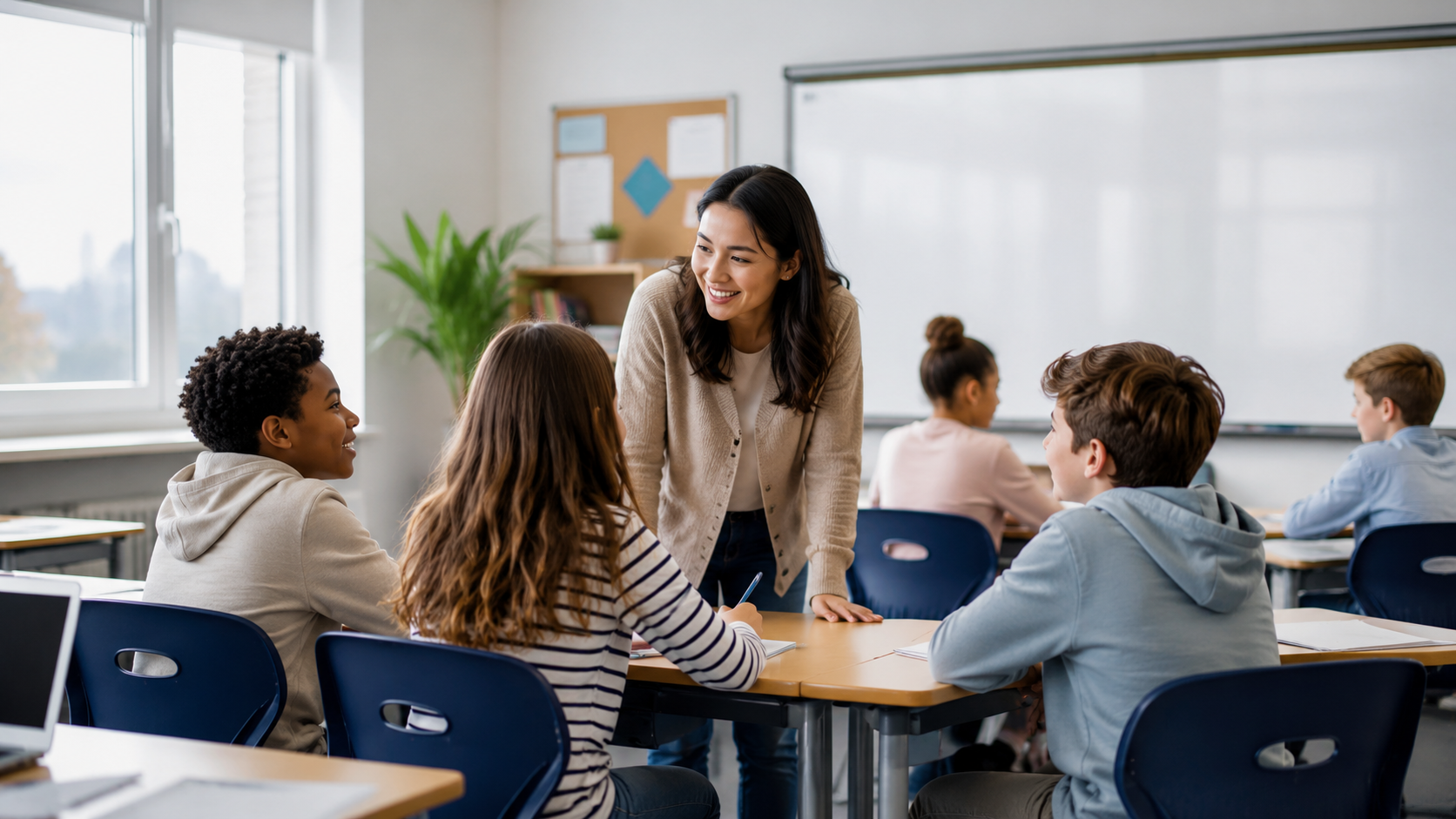
Teacher communicating with students in an organized classroom
Rows are useful for individual study, while paired or grouped desks are more suitable for discussion and project work.
Classroom furniture should allow teachers to adjust the layout according to different teaching activities.
Students should be able to see the teacher, board, and presentation area clearly. Teachers also need a clear view of the room so they can notice confusion or distraction.
Furniture height and desk arrangement should not block communication between the front and back of the classroom.
Adequate aisle space allows teachers to reach students more easily. It also helps learners enter and leave their seats without disturbing others.
Before ordering furniture, schools should confirm classroom dimensions, student numbers, door positions, and required teaching areas.
Furniture does not replace good teaching, but it can create a more practical setting for communication and participation.
For a classroom furniture wholesale project, buyers should consider student age, desk height, chair dimensions, room layout, storage needs, surface materials, and expected class size.
Our factory supplies school desks, chairs, Reading Tables, nap furniture, and other campus furniture. We support different sizes, colors, structures, logos, and packaging requirements for schools, distributors, and education projects.
Sample confirmation before mass production can help buyers check furniture dimensions, stability, layout suitability, and appearance.
Teachers can build stronger relationships by listening carefully, providing clear feedback, giving students different ways to participate, and maintaining fair classroom routines.
A well-organized classroom can support these efforts by improving visibility, movement, communication, and group interaction.
Planning a school renovation or classroom furniture wholesale order? Send us your classroom dimensions, student age group, required quantity, preferred layout, and customization details. We will recommend suitable furniture options and prepare a quotation for your project.
 Email:


