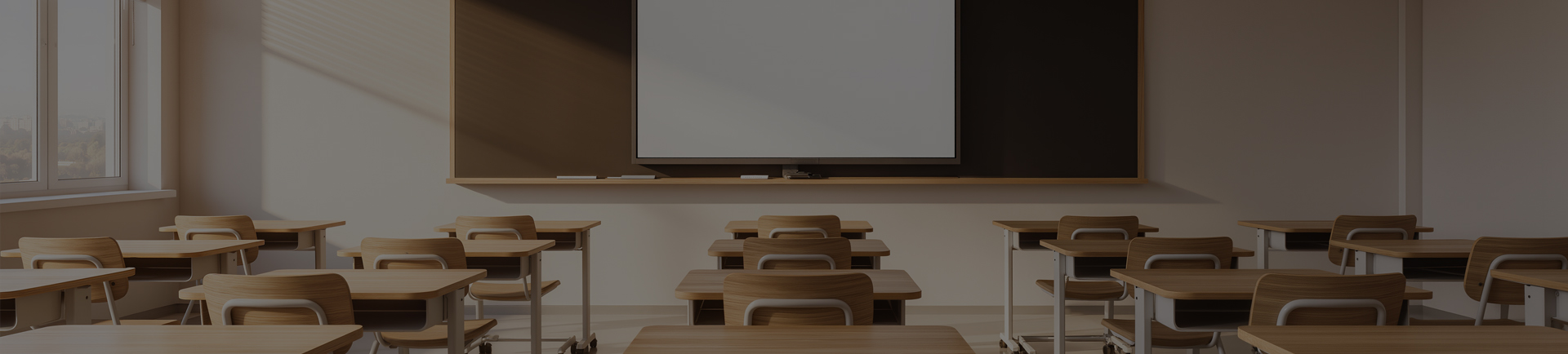
Single student desks vs two-person desks is a practical classroom planning decision involving space, teaching style, behavior management, storage, and procurement cost. Single desks provide each learner with a defined workstation and allow flexible rearrangement. Two-person school desks can reduce the number of frames in a room, support paired learning, and create orderly shared rows.
Neither format is automatically better. A school should compare the complete occupied layout and daily teaching routine before choosing.
A single student desk gives one learner an individual writing surface. It is easy to assign, separate for examinations, or combine into temporary pairs and groups. If a classroom uses frequent layout changes, separate units provide many configuration options.
Single desks can also simplify maintenance because a damaged unit can be removed without disturbing a partner’s place. Adjustable versions allow staff to set different heights within the same room when student size varies.
The disadvantages are operational. More desks mean more frames, feet, and individual items to move or count. Narrow lightweight models may shift out of alignment, and badly planned storage can leave bags in the aisles.
A two-person desk uses one shared top or connected structure for two learners. It naturally supports pair discussion and can create a visually consistent classroom with fewer separate furniture units.
Shared desks may use steel efficiently and can reduce assembly time per seat, depending on the design. They are often suitable for classrooms that rely on stable rows and regular paired work.
However, both students must accept the same desk height, surface position, and shared boundary. A damaged top or frame may affect two seats at once. Two-person units are usually more cumbersome to move, and separating students during assessment requires additional planning.
Do not compare only the overall desktop width. Divide the clear writing area by the number of users and consider book placement, elbow room, devices, and the center boundary.
A two-person desktop must be wide enough for both students to work without continual conflict. Its support structure should not place a leg or brace where one user needs knee space. Single desks should provide enough depth for learning materials without extending rows too far into circulation routes.
Our comfortable student desk chairs use a 600 × 400 mm individual desktop, giving planners a concrete size to test in a classroom mock-up.
Single desks win when a teacher frequently changes from rows to pairs, clusters, or a U-shaped discussion layout. Their size and weight should permit controlled movement while the frame remains stable during writing.
Two-person desks win when a school wants a fixed arrangement with fewer separate pieces. A larger base can feel stable, although good stability ultimately depends on frame geometry, floor contact, connections, and manufacturing accuracy—not simply width.
Individual desks create clearer personal boundaries. They can help during independent work and allow teachers to change the spacing between particular students. They also make assigned seating easy to record.
Two-person desks encourage peer interaction and material sharing. This can support language practice, partner exercises, and mutual assistance, but it can also create distraction when the activity requires concentration.
Schools should ask teachers which mode occupies most lesson time. Purchasing furniture for rare activities can make every ordinary class less efficient.
Both desk types can include book boxes, shelves, or bag hooks. Storage should not reduce legroom or create projections into aisles. A shared book box needs clear division if personal materials must remain separate.
Cleaning staff need access beneath and around the desk. Two-person models have fewer units to reposition but may be heavier. Single desks are lighter individually but create more legs and contact points. Smooth coating, protected edges, replaceable foot caps, and accessible surfaces matter in either case.
Unit price can be misleading because one two-person desk serves two students. Compare the delivered and installed cost per seat, including chairs, packing volume, assembly labor, spare parts, and expected replacement.
Also consider flexibility as an economic factor. If room use changes, single desks may be redeployed more easily. If the layout will remain stable for years, two-person desks may simplify the furniture count.
For a bulk order of single and two-person student desks, buyers should provide quantities by model, desk and chair dimensions, material specifications, colors, storage requirements, packaging marks, and delivery sequence. Mixing models without a clear room schedule can complicate installation even when every product is correct.
Our factory manufactures Student Desks and Chairs along with Reading Tables, nap furniture, Dormitory Beds, and canteen furniture. We can coordinate single and shared classroom configurations with steel-tube frames, laminated or molded components, book boxes, powder-coated finishes, private logos, and disassembled export cartons.
Production control covers material confirmation, cutting and forming, welding, surface treatment, component fit, dimensions, stability checks, appearance inspection, and packing. OEM/ODM support allows distributors and education-project buyers to adjust size, color, details, and labeling to the target market.
An approved sample or pilot classroom helps verify how the two desk formats behave in real use. Test chairs in the working position, student movement, writing space, floor stability, cleaning access, and the time required to rearrange furniture.
Choose single student desks when:
Independent work and assessment are frequent
Layouts change regularly
Different desk heights may be needed in one room
Individual replacement and assignment are priorities
Choose two-person desks when:
Paired learning is common
Rows remain stable for long periods
The school wants fewer furniture units to manage
Both users can comfortably share one size and surface
Choose a mixed plan when different rooms have different teaching purposes. Standard classrooms might use single desks, while language rooms or dedicated pair-work spaces use two-person models.
Single student desks are generally better for flexibility, personal space, and assessment. Two-person desks are generally better for stable paired seating and simplified unit management. The right answer comes from measuring the occupied classroom, calculating cost per usable seat, and matching furniture to the teaching method.
Whichever format is selected, consistent dimensions, durable construction, accessible storage, safe edges, stable floor contact, and repeatable factory production determine whether the furniture performs well after installation.
 Email:


