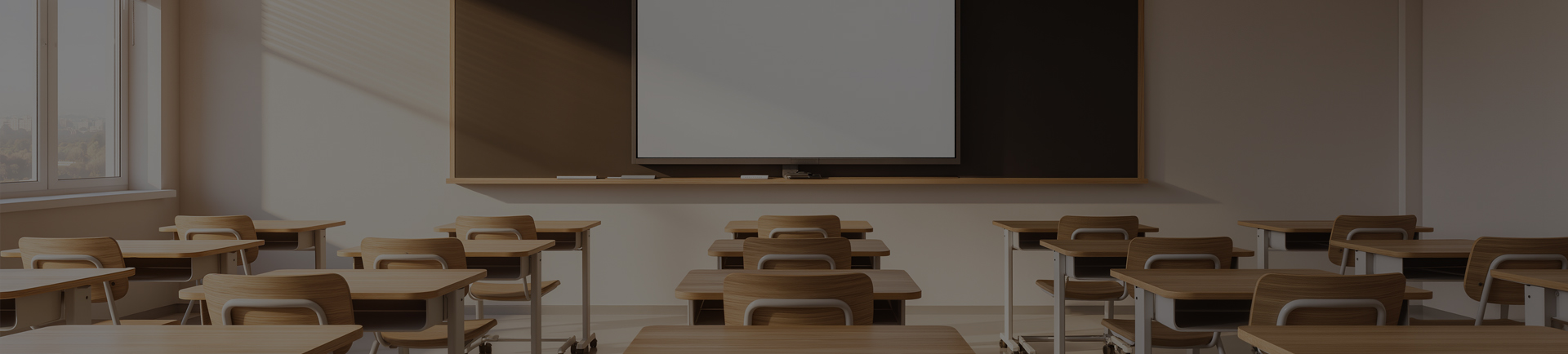
Collaborative tables and individual desks serve different educational purposes. Collaborative tables encourage communication and shared activities, while individual desks provide personal working space, clearer seating arrangements, and stronger separation during independent tasks. Early elementary classrooms often benefit from a combination of both formats.
Young students need opportunities to work independently, but they also learn through discussion, hands-on activities, and group participation. Furniture should therefore support the teaching method rather than define it.
Individual desks give each child a clearly defined learning area. Books, notebooks, stationery, and classroom materials can remain within the student’s working space.
Their advantages include:
Personal writing space
Easier individual assessment
Clear seating assignments
Better control during examinations
Flexible row arrangements
Simple replacement or rearrangement
Individual desks are suitable when teachers need students to focus on independent reading, handwriting, tests, or worksheet activities.
For early elementary students, the desk should be appropriately sized. A large desktop may be unnecessary, while an oversized frame can make it difficult for children to sit comfortably.
Collaborative tables are designed for several students to work together. They may be rectangular, square, circular, or modular depending on the classroom plan.
They support:
Group reading
Art activities
Science projects
Classroom discussion
Puzzle and game work
Shared learning materials
Teacher-led small groups
The table should provide enough space for each student without creating crowding. The shape also influences teacher access and student communication.
A round table may encourage face-to-face discussion, while a rectangular table may be easier to arrange in rows or against a wall.
| Factor | Collaborative Tables | Individual Desks |
|---|---|---|
| Group work | Excellent | Moderate |
| Independent study | Moderate | Excellent |
| Classroom flexibility | High | High |
| Personal storage | Limited or shared | Easier to provide |
| Examination use | Less suitable | Very suitable |
| Teacher supervision | Depends on layout | Easy by row |
| Space use | Efficient for groups | Flexible for separate seating |
| Student interaction | High | More controlled |
The best solution depends on the daily teaching pattern. A classroom based mainly on independent work may require more individual desks, while a project-based classroom may need more collaborative tables.
There is no single answer for every classroom. Early elementary education combines individual skill development with social learning.
Individual desks may be preferable for:
Handwriting practice
Reading tests
Quiet assignments
Personal drawing
Student assessments
Lessons requiring concentration
Collaborative tables may be better for:
Group storytelling
Art and craft
Team projects
Classroom games
Science demonstrations
Shared reading
Teacher-guided activities
A mixed layout can provide both advantages. For example, individual desks may be used for the main lesson, while one or two collaborative tables can be placed in a reading or activity area.
Furniture for younger children should be easy to approach and should not create avoidable injury risks.
Important details include:
Rounded corners
Smooth surfaces
Stable legs
Secure frame connections
Suitable table height
Easy-to-clean finishes
No exposed sharp edges
No easily accessible pinch points
The furniture should also remain stable when children lean, move, or place materials on the surface. Stability is especially important for collaborative tables because several students may use the same structure at once.
XIAOYING focuses on ergonomic and safety design for educational environments. Its product scope includes Student Desks and Chairs, Reading Tables, collaborative desks, and other campus furniture.
Furniture arrangement changes how teachers communicate with students. Rows provide a clear forward-facing structure, while groups create more opportunities for discussion.
A classroom may use:
Rows for direct instruction
Pairs for reading practice
Small groups for projects
Open areas for activities
Reading tables for quiet study
Furniture that can be rearranged helps schools adapt the same classroom to different lessons. However, movable tables should remain manageable for teachers and staff. Excessively heavy furniture may reduce the practical value of flexibility.
School administrators and project buyers should review:
Classroom dimensions
Number of students
Student age and height
Teaching style
Required storage
Cleaning procedures
Furniture movement frequency
Color and appearance
Budget and replacement plan
A Wholesale Supplier of collaborative school tables should be able to offer different sizes, shapes, finishes, and packaging options. For a Bulk Order of early elementary classroom furniture, consistent table dimensions help schools standardize classroom layouts across different buildings.
Educational furniture requires an understanding of more than basic furniture production. The supplier should consider child safety, classroom use, ergonomic dimensions, repeated handling, and long-term maintenance.
XIAOYING has specialized in educational equipment since 2003. Its product range covers school desks and chairs, reading tables, Dormitory Beds, Folding Beds, and canteen furniture. The company has served more than 5,000 schools and exported products to more than 50 countries according to its company information.
Its reading tables and collaborative desk products can be developed for classrooms, libraries, study areas, and project-based learning environments.
An OEM ODM Manufacturer of classroom furniture can adjust:
Table dimensions
Tabletop shape
Student capacity
Frame color
Edge treatment
Storage functions
Surface finish
Carton packaging
Product combinations
This is useful for education furniture brands and school contractors that need a coordinated product range for different age groups.
XIAOYING supports product development, sampling, mass production, and quality inspection. Its ISO9001 quality management system provides a structured basis for production and service management.
Collaborative tables are strong for communication, group projects, and shared learning. Individual desks are better for personal work, tests, and clear classroom organization. Early elementary classrooms often achieve the most flexibility by combining both types.
The final decision should consider teaching activities, student age, classroom dimensions, safety, storage, and movement requirements. XIAOYING supplies customized school furniture for distributors, schools, contractors, and educational project buyers seeking stable Export Quality classroom furniture supply.
 Email:


